Évian G7 in Review: Russian Escalation, the U.S-Iran Memorandum, and the Road to Ankara
Updated: Jun 29
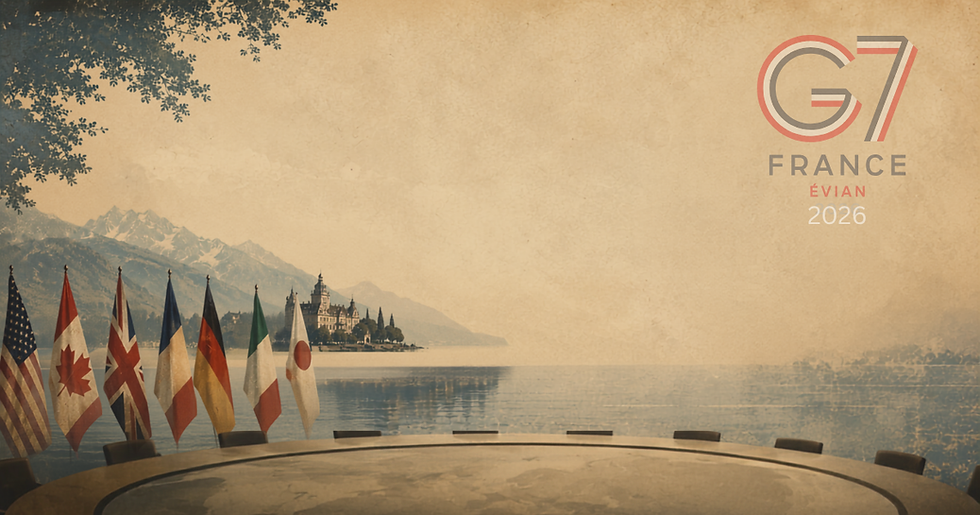
The 52nd G7 Summit concluded in Évian-les-Bains on 17 June 2026, but the gathering that emerged looked different from the one France had planned. Paris had hoped to focus on economic resilience, critical minerals, and artificial intelligence governance. Instead, leaders spent much of the summit responding to a rapidly changing security environment shaped by developments around Iran and Ukraine. More than any formal agenda item, these events defined the tone and outcomes of the meeting.
Two developments shaped the summit before it began. First, Washington and Tehran reached a memorandum of understanding aimed at reopening the Strait of Hormuz and creating a framework for further negotiations. Second, Russia struck Kyiv’s Pechersk Lavra, a UNESCO World Heritage site, in one of the most significant attacks on the complex since the war began. Coming at a time when Russian forces faced deepening military and economic pressures, the strike was widely interpreted by Western leaders as a sign of frustration rather than strength. Together, these developments contributed to a more constructive atmosphere among G7 leaders and helped produce a level of unity that had appeared uncertain only weeks earlier. This was also reflected in “objectively a success” from the leader's final assessments.
Iran: A Memorandum of Understanding (MoU) with Strategic Consequences
The U.S-Iran memorandum significantly influenced the diplomatic mood in Évian. This was symbolically followed by President Macron’s invitation to the official dinner at the Palace of Versailles and President Trump’s official signing of the treaty with Iran. The agreement included a halt to military operations, partial sanctions relief, and 60-days for follow-on negotiations: nuclear issues, ballistic missiles, and regional activities. If other countries have ballistic missiles, “it’s a little bit unfair for Iran not to have some,” Trump told reporters in France. “If Saudi Arabia and Qatar all have some, in relative proportion, I think it’s OK.” In the meantime, financial markets responded positively, with energy prices falling as concerns over disruptions in the Strait of Hormuz eased.
For G7 leaders, the agreement had implications beyond the Iran conflict. Reducing the immediate risks of escalation created political space for cooperation on broader security issues. The discussions also included a firm and immediate ceasefire in Lebanon and support for the Lebanese authorities’ effort to disarm Hezbollah and state monopoly on weapons. As well as macroeconomic imbalances, digital technology, and AI. European leaders welcomed the memorandum as an opportunity to stabilize global energy markets and reduce uncertainty during geostrategic tensions.
The current ending of the war with Iran came at the cost of major US concessions. The longer-term significance of the agreement remains uncertain. During his press conference following the G7 Summit, President Trump has strictly threatened to resume the bombing campaign if Iran doesn’t “behave”. The agreement's text commits the United States and its regional partners (Gulf States) to develop a plan of at least $300 billion for Iran's reconstruction and economic development, with the financing mechanism to be finalized within 60 days as part of the final deal. Yet the source of these funds remains contradictory within the U.S administration itself. Also, there is no political guarantee that would stop Iran from blocking the Strait of Hormuz again.
The next phase of negotiations will determine whether the memorandum becomes the foundation for a more durable diplomatic framework or merely a temporary pause in tensions. A successful outcome could improve regional stability and strengthen global economic confidence. Failure, however, could quickly revive sanctions disputes, maritime security concerns, and the risk of wider confrontation.
Ukraine: French Diplomacy and Rebuilding Allied Consensus
France’s most visible achievement at Évian was diplomatic. President Emmanuel Macron worked to ensure that Ukraine remained central to the summit’s discussions and successfully secured President Volodymyr Zelensky’s participation. A dedicated session on Ukraine and European security culminated in a genuine strategic awakening by renewed commitments to increase military and air-defense assistance. As well as additional pressure on Russian energy revenues through sanctioning Russian oil and gas.
The summit also reflected a notable shift in transatlantic dynamics. Macron emphasized that leaders shared the view that Moscow had shown no genuine willingness to engage seriously in peace negotiations. G7 leaders also welcomed Trump’s shift on rebuilding support for Ukraine. While differences among allies remain, Évian demonstrated a greater degree of alignment than many observers had expected at the beginning of the year.
This renewed consensus should also be understood in the context of developments on the battlefield. Russian recruitment challenges, pressure on energy revenues, and continuing Ukrainian strikes against logistics networks have complicated Moscow’s position. Against this backdrop, the attack on the Pechersk Lavra reinforced perceptions among G7 leaders that sustained support for Ukraine remains necessary.
Toward Ankara NATO Summit: Will Allied Cohesion Endure?
The summit’s real significance may become clearer at the NATO Summit in Ankara. NATO leaders will arrive there carrying commitments made in France, making Ankara the first major test of whether summit unity can be translated into policy.
Three questions stand out. First, will commitments on air defense, sanctions, and military assistance move from declaration to implementation quickly enough to influence Ukraine’s position ahead of the coming winter? Second, will Russia’s loss of momentum continue, reducing the likelihood of further escalation, or will Moscow seek new ways to regain the initiative? Third, can the diplomatic momentum generated by the Iran memorandum survive the next phase of negotiations and contribute to a broader period of regional and transatlantic stability?.
The answers will determine whether Évian represented a lasting strategic recalibration or simply a temporary convergence of interests. For now, the summit demonstrated that core developments in Iran, Ukraine, Lebanon, and emerging technologies are increasingly interconnected. Whether that unity can be sustained will be one of the defining questions facing the Euro-Atlantic alliance in the months ahead.
Conclusion
Évian’s importance lies less in the declarations it produced than in the strategic trajectories it revealed. A temporary easing of tensions with Iran created space for greater cooperation among allies, while Russia’s current lack of initiative and actions reinforced support for Ukraine at a moment when consensus had appeared fragile. At the same time, the summit highlighted that artificial intelligence, economic security, and traditional geopolitics are becoming part of the same policy conversation.
The outcome of U.S-Iran negotiations, the evolution of the war in Ukraine, and decisions taken in Ankara will determine whether the cohesion displayed in Évian marks the beginning of a more durable Western strategy. The summit offered no final answers, but it clarified the key tests that now lie ahead.
_________________________________________
By Tinatin Gachechiladze - Head of Transatlantic Area Program at the Strategic Security Initiative (SSI)
Photo: OpenAI

Comments